

Introduction: Why Baccarat Attracts So Many Myths
Few casino games carry as much folklore as baccarat. Players in Bangkok, Macau, Manila and online rooms all trade the same stories: hot streaks, pattern reading, “due” outcomes, and secret systems that supposedly turn the tables. Yet when mathematicians and probability specialists examine the game, they arrive at very different conclusions from the tips passed around at the table.
This guide sets aside superstition and looks at what the mathematics actually says. If you play บาคาร่า for entertainment, understanding the real numbers protects your bankroll far more effectively than any myth ever will. The good news is that baccarat is one of the few casino games where the smartest mathematical decision is also the simplest one to remember.
How Baccarat Actually Works From a Math Perspective
Before discussing strategy, it helps to understand what you are betting on. In each hand, two hands are dealt: the Player hand and the Banker hand. You are not one of these hands. You are simply choosing which of the two will land closest to nine, or whether they will tie. The dealing rules for a third card are fixed and mechanical, which means no skill on the part of the dealer or the player changes anything about how the hand resolves.
Because the rules are fixed, the outcomes can be calculated exactly. Using a standard eight-deck shoe, statisticians have simulated billions of hands to determine the true probability of each result.
The Real Probabilities of Each Outcome
| Outcome | Probability | Frequency Per 100 Hands |
|---|---|---|
| Banker wins | 45.86% | About 46 hands |
| Player wins | 44.62% | About 45 hands |
| Tie | 9.52% | About 9 to 10 hands |
Notice that Banker wins slightly more often than Player. This is not random chance or a lucky feature of any specific table. It is baked into the rules of how the third card is drawn. The Banker hand acts second and benefits from additional information, which gives it a small but consistent edge over the Player hand.
The House Edge on Every Bet
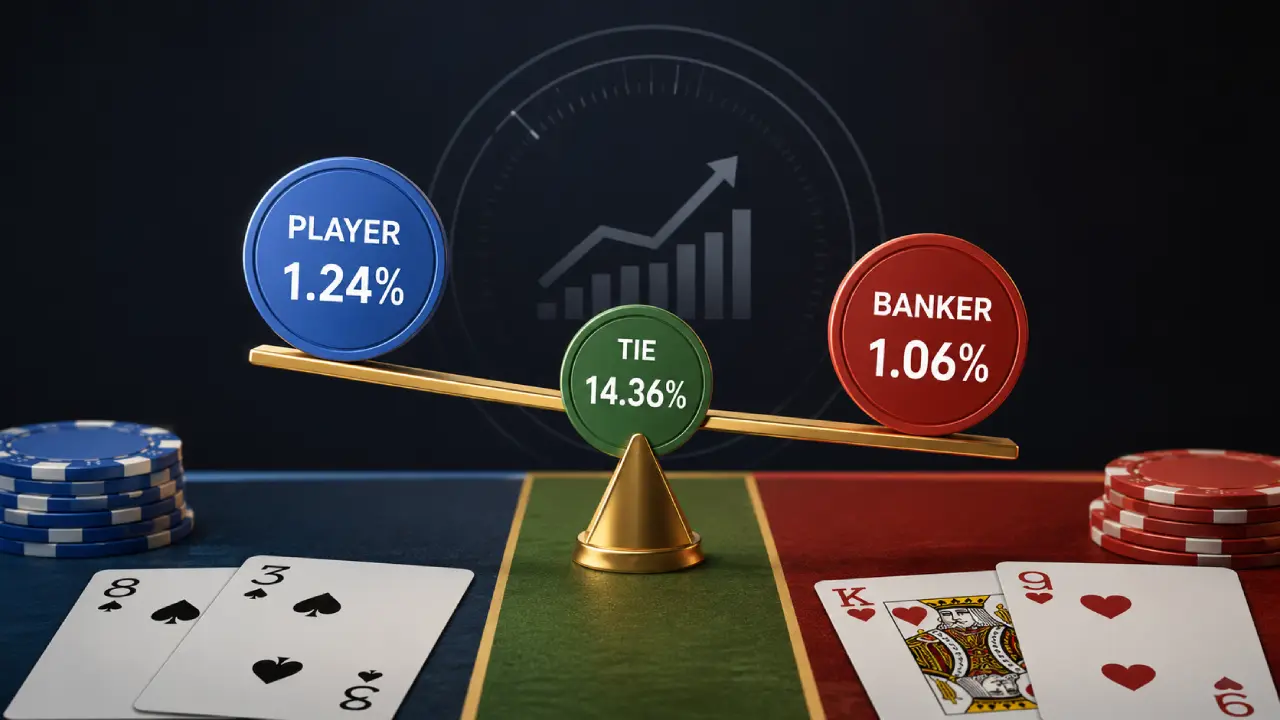
The most important number in baccarat is the house edge. This is the percentage of every bet you place that the casino statistically keeps over the long run. A lower house edge means your money survives longer at the table. Here is what the math actually shows.
House Edge Comparison Table
| Bet Type | Payout | House Edge | Notes |
|---|---|---|---|
| Banker | 1:1 minus 5% | 1.06% | Lowest edge in the game |
| Player | 1:1 | 1.24% | Second lowest |
| Tie (8:1 payout) | 8 to 1 | 14.36% | High risk, avoid |
| Tie (9:1 payout) | 9 to 1 | 4.85% | Still worse than Banker or Player |
| Pair side bets | 11:1 | 10.36% | Marketing bet, not a strategic one |
The mathematical takeaway here is not subtle. The Banker bet offers the lowest house edge of any main bet in the casino, alongside blackjack played with perfect basic strategy. The Player bet is only slightly worse. Everything else is significantly weaker from a math standpoint, no matter how attractive the payouts appear.
What Math Actually Recommends
If you are only interested in what the numbers say, the entire strategy fits into one sentence: bet Banker consistently, ignore side bets, and stop chasing patterns. That is it. There is no hidden layer, no complicated system, and no secret technique that mathematically outperforms this approach in the long run.
Let us look at why each part of that recommendation holds up.
Why Banker Is the Mathematically Correct Bet
Even after the 5% commission is subtracted from your winnings, Banker still returns more of your money than any other choice at the table. Over a full shoe of about 70 to 80 hands, a Banker-only strategy loses money more slowly than any alternative main bet. The commission feels annoying in the moment, but the numbers already account for it. That is why the house edge stays at 1.06% and not something worse.
Some casinos offer commission-free Banker bets. Read the rules carefully, because these versions usually pay only half or nothing on a Banker win of six. That rule change increases the house edge to somewhere around 1.46%, making commission-free Banker mathematically worse than the standard version.
Why Player Is a Reasonable Second Choice
The Player bet has a slightly higher house edge at 1.24%, but it has one small advantage. No commission is taken, which means every winning bet returns the full amount. Some players prefer the psychological simplicity of Player, and the math penalty is small enough that this is a perfectly acceptable choice. The gap between Banker and Player is only 0.18%, or roughly 18 baht for every 10,000 baht wagered.
Why the Tie Bet Is Always Wrong
The Tie bet advertises an eye-catching payout, but a house edge above 14% is one of the worst propositions in any casino. On average, you would lose over 1,400 baht for every 10,000 baht wagered on Tie over the long run. No pattern, hunch, or streak changes this. Serious mathematical models treat the Tie bet as a marketing feature, not a strategic option.
The Myths That Cost Players the Most Money
The gap between what people believe and what the numbers show is where casinos make most of their profit. Below are the myths that mathematics has repeatedly disproved.
Myth 1: The Martingale System Beats Baccarat
Martingale tells you to double your bet after every loss so that a single win recovers all previous losses plus one unit of profit. It sounds logical until you see what happens when the losing streak continues.
| Consecutive Losses | Bet Required (Starting at 100 THB) | Total Money Risked |
|---|---|---|
| 1 | 100 | 100 |
| 3 | 400 | 700 |
| 5 | 1,600 | 3,100 |
| 7 | 6,400 | 12,700 |
| 9 | 25,600 | 51,100 |
| 11 | 102,400 | 204,700 |
Two problems break the system. First, table limits will stop you from doubling long before your bankroll runs out. Second, losing streaks of eight or more happen more often than people expect. Even a 45% chance of winning still produces a losing streak of ten or more in the average shoe. Martingale does not beat the house edge. It concentrates losses into rare but devastating sessions.
Myth 2: Pattern Boards and Road Maps Predict the Future
Baccarat tables show elaborate scoreboards called the Big Road, Big Eye Boy, Small Road and Cockroach Road. Casinos display them because players believe patterns matter. Mathematically, each hand is independent. The shoe does not remember what happened three hands ago, and the deck has no memory of the players. If Banker has just won six times in a row, the probability of Banker winning the next hand is still 45.86%. Not more, not less.
Tracking patterns is harmless entertainment. Betting money based on them changes nothing about the math.
Myth 3: A Win Is “Due” After a Long Streak
This is the gambler’s fallacy, and it is arguably the most expensive myth in gambling. If Player has lost ten hands in a row, the eleventh hand still has the same 44.62% probability of a Player win. The past does not owe the future anything. Random outcomes distribute unevenly in small samples, and streaks are a completely normal part of that distribution.
Myth 4: Card Counting Works in Baccarat
Card counting is powerful in blackjack because the composition of the remaining deck significantly affects your expected outcome. In baccarat, mathematicians including Edward Thorp studied the game in the 1960s and found that even with a perfectly counted shoe, the edge shifts you might exploit are so small and so rare that the effort is not worth it. The average expected gain from counting an entire baccarat shoe is often less than 0.01% per hand.
Myth 5: Progressive Systems Like Paroli or Fibonacci Beat the House
These systems change the size of your bet based on wins or losses. Paroli increases bets after wins. Fibonacci increases bets after losses following the famous number sequence. All of them share the same fatal flaw: they change how you bet but not what you bet on. Since the house edge is a percentage of every wager, changing the sequence of bet sizes does not change the long-term outcome. It only changes how quickly you win or lose.
The One Strategy That Actually Improves Your Results

Since the mathematics of the game itself cannot be beaten with a betting system, the only real strategy is managing what you can control. Bankroll management is the closest thing to a genuine baccarat strategy.
A Sensible Bankroll Framework
| Session Length | Recommended Bankroll | Base Bet Size | Maximum Session Loss |
|---|---|---|---|
| 1 hour | 100 units | 1 unit | 40 units |
| 2 to 3 hours | 200 units | 1 unit | 80 units |
| Full evening | 300 to 400 units | 1 unit | 120 units |
A unit is whatever amount is comfortable to lose without regret. It might be 50 baht for one player and 500 baht for another. The math applies the same at any scale. The idea is to give your bankroll enough room to survive the natural variance of the game, while capping losses so a bad session does not damage your finances.
Set Win Limits Too
Most articles emphasize loss limits, but mathematics also suggests setting a walk-away point for wins. Because the house edge is small but persistent, sessions that go well tend to give the money back if you keep playing. Locking in a win of 30% to 50% above your starting bankroll is a mathematically sound way to leave the table ahead over time.
What Realistic Expectations Look Like
Even with the mathematically best strategy of betting Banker exclusively, you should still expect to lose money over the long run. The house edge of 1.06% is small, but it is not zero. For every 10,000 baht you wager, the game will statistically keep about 106 baht.
The reason baccarat feels beatable is short-term variance. You can absolutely walk away a winner tonight. You can also win consistently for a week. But given enough hands, the math converges toward the expected result. This is why professional gamblers do not play baccarat as a career. There is no advantage play available in the game itself.
Understanding this makes baccarat more enjoyable, not less. If you treat the table as entertainment with a known cost, similar to buying tickets to a concert or a football match, you can enjoy the atmosphere without the emotional damage of chasing losses.
A Simple Mathematical Baccarat Playbook
To summarize what the mathematics genuinely recommends, here is a compact reference you can use at any table.
| Rule | Reason |
|---|---|
| Bet Banker almost every hand | Lowest house edge in the game at 1.06% |
| Skip Tie bets entirely | House edge of 14% is prohibitive |
| Skip side bets like pairs | Marketing propositions with poor math |
| Ignore pattern boards | Hands are independent, patterns are illusions |
| Set a session bankroll | Protects against normal negative variance |
| Set win and loss walk-aways | Locks in results before variance reverses them |
| Do not use Martingale | Risks catastrophic loss for tiny gains |
| Treat it as entertainment | The math says you will lose slowly over time |
Conclusion: Simplicity Wins
The most surprising thing about baccarat is how straightforward the optimal strategy really is. There is no complicated formula, no hidden edge, and no clever system that changes the underlying math. You simply pick the Banker bet, size your wagers responsibly, and enjoy the game as entertainment rather than an income source.
Everything else, from pattern reading to progressive betting systems, exists because gambling myths are more exciting than mathematical reality. The players who understand the truth spend less, play longer, and walk away with fewer regrets. That, according to the math, is the best baccarat strategy there is.