

Edge sorting is a casino technique where players use tiny manufacturing flaws on the backs of playing cards to identify high-value cards before they are revealed. The method works because some card backs have patterns that aren’t perfectly symmetrical. When you can spot these differences, you gain information about face-down cards that most players don’t have.

This technique became famous when professional poker player Phil Ivey won millions of dollars using edge sorting at major casinos. The casinos took him to court, and judges had to decide whether edge sorting was a clever gambling strategy or actual cheating. The cases raised important questions about what counts as fair play in casinos.
You might wonder if edge sorting is legal and whether you could use it yourself. The truth is more complicated than a simple yes or no answer. Understanding how edge sorting works, why it became controversial, and how casinos now protect themselves will help you grasp this fascinating part of gambling history.
What Is Edge Sorting?
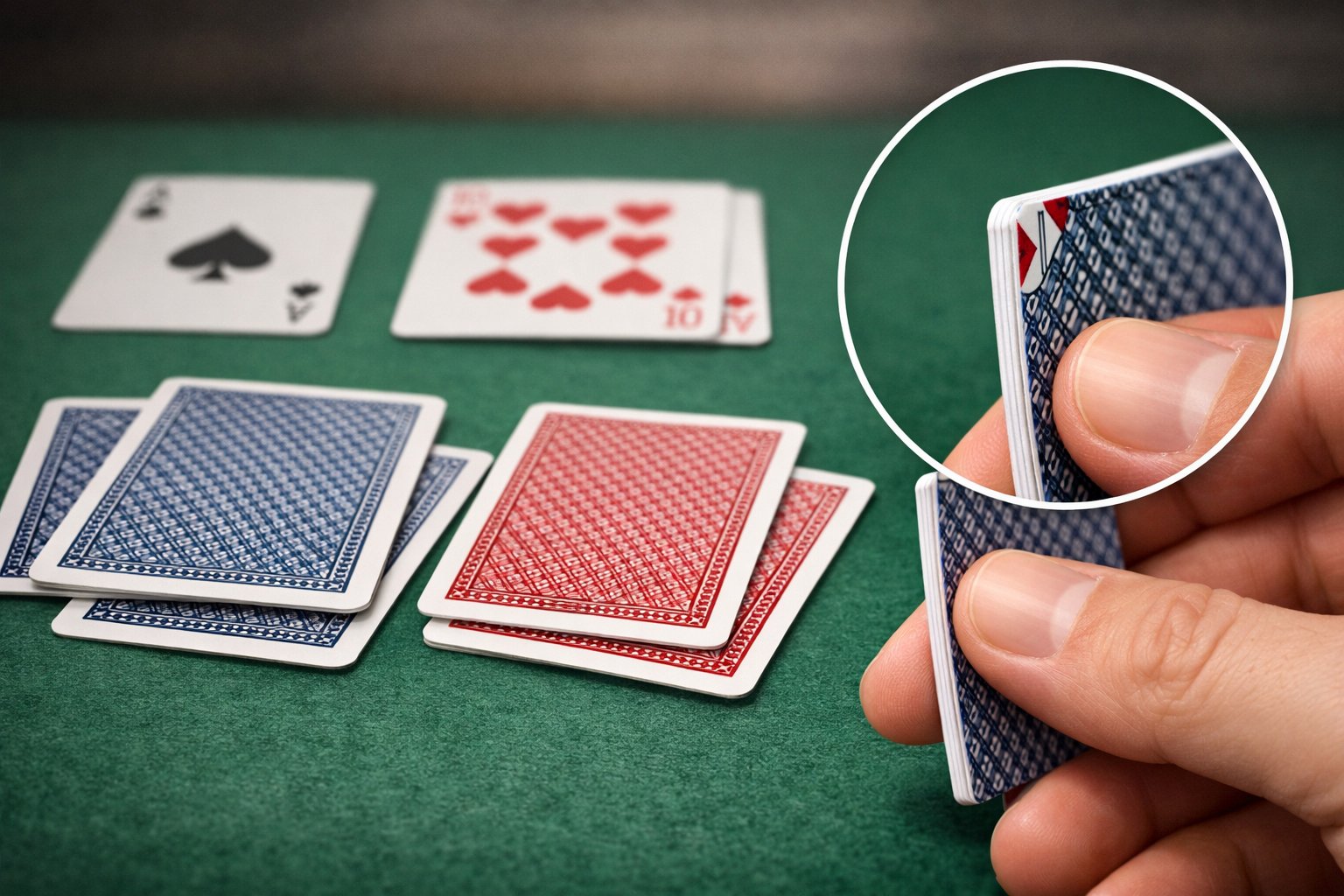
Edge sorting is an advantage play method where you identify the value of face-down cards by spotting tiny flaws on their backs. This technique gives you an edge by letting you know whether high-value or low-value cards are coming before they’re revealed.
Definition and History
Edge sorting works because some playing card manufacturers produce decks with backs that aren’t perfectly symmetrical. The patterns on the card backs may have slight differences along the edges. You can use these differences to tell cards apart when they’re face-down.
The technique became famous in 2012 when poker player Phil Ivey used it to win over $10 million at Crockfords Casino in London. He won a similar amount at Borgata Casino in Atlantic City. Ivey worked with Cheung Yin “Kelly” Sun, who was skilled at spotting card flaws.
During their casino sessions, they made specific requests. They asked for certain card brands known to have pattern issues. They requested that dealers rotate high cards, claiming it was for good luck. They also insisted on manual shuffling and using the same deck for multiple rounds.
Both casinos refused to pay or sued to recover their money. Courts ruled that Ivey violated the spirit of the game, even though he didn’t technically break casino rules. These court cases made edge sorting well-known in the gambling world.
Edge Sorting Versus Card Counting
Edge sorting and card counting are different advantage play strategies with distinct approaches.
| Aspect | Edge Sorting | Card Counting |
|---|---|---|
| Game | Primarily Baccarat | Blackjack |
| Method | Identifying cards by back patterns | Tracking cards already played |
| Setup Required | Flawed deck and card rotation | Mental calculation system |
| Detection | Harder to spot initially | Easier to identify |
Card counting requires you to track which cards have been played and adjust your bets based on what’s left in the deck. Edge sorting lets you identify specific cards before they’re revealed.
Card counting works in Blackjack where deck composition matters. Edge sorting works best in Baccarat where cards are dealt face-down. You need different skills for each method. Card counting needs strong math and memory skills. Edge sorting needs excellent vision and the ability to convince dealers to rotate cards.
Key Terms and Concepts
Asymmetrical patterns are the manufacturing flaws that make edge sorting possible. Card backs should look identical from all angles, but some decks have patterns that differ slightly on opposite edges.
Card rotation is how you organize the deck to your advantage. You persuade the dealer to turn certain cards 180 degrees. High-value cards face one direction while low-value cards face another.
Edge refers to the long sides of playing cards where pattern differences are most visible. You watch these edges to identify card values.
Advantage play describes legal strategies that give you an edge over the casino. This includes edge sorting, card counting, and other tactics that don’t involve cheating or breaking rules.
House edge is the casino’s built-in advantage in any game. Baccarat already has a low house edge, which is why even small improvements in your ability to predict cards can make the game profitable for you.
How Edge Sorting Works
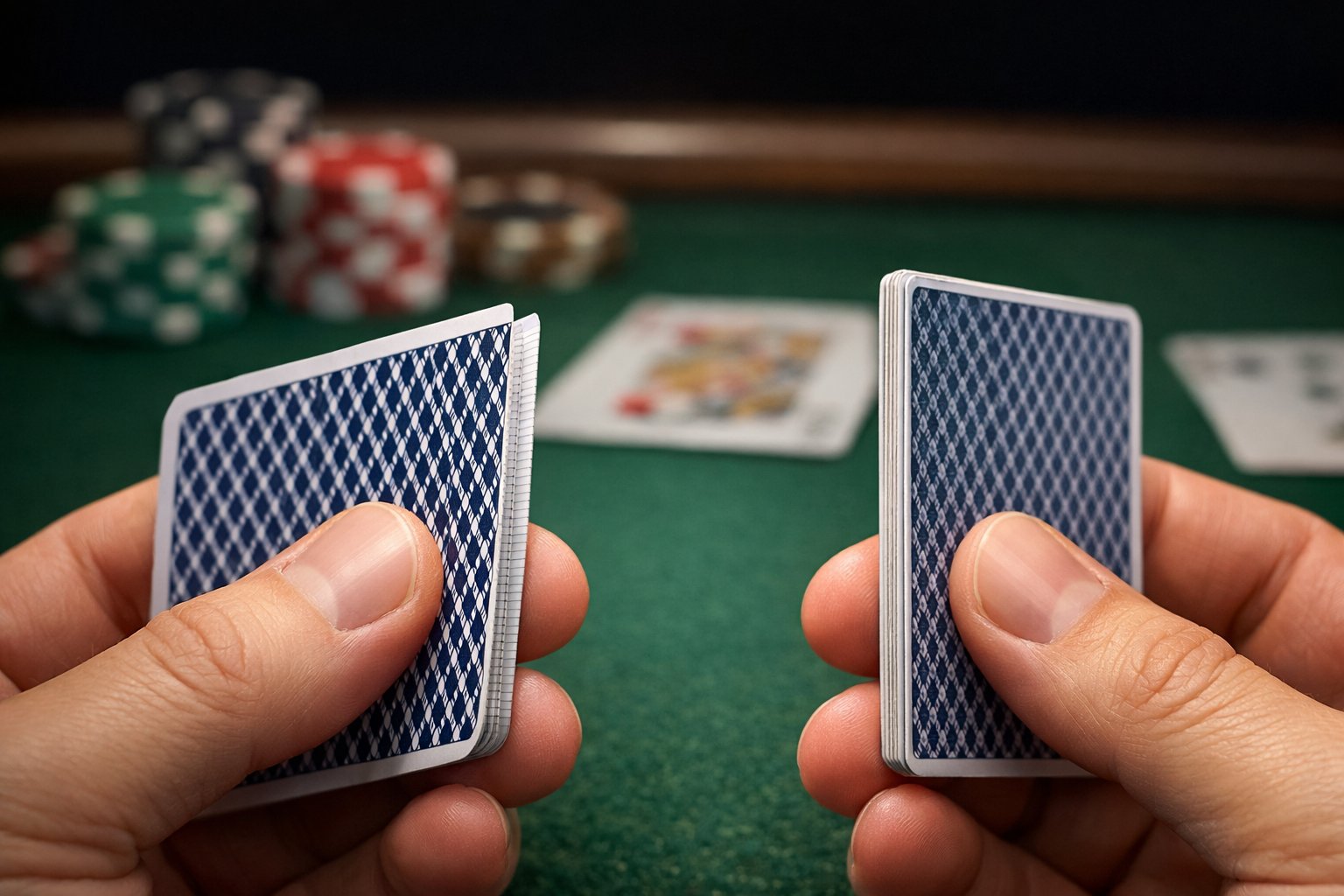
Edge sorting relies on spotting tiny flaws in card patterns, manipulating how cards face, and avoiding shuffling methods that reset card positions.
Identifying Card Imperfections
The edge sorting technique starts with finding cards that have uneven patterns on their backs. Card manufacturers sometimes produce decks where the printed design doesn’t line up perfectly on all four edges. These flaws are usually invisible from a distance but become noticeable when you look closely at the card edges.
You need to focus on the long edges of the cards rather than the short ends. The pattern might show more diamonds on one side or have a border that’s slightly thicker on one edge compared to the opposite edge. These differences are tiny, often less than a millimeter, but they’re enough to tell cards apart.
High-value cards like 7s, 8s, and 9s in baccarat are your main targets. Once you spot which pattern belongs to high cards versus low cards, you can start building an advantage. The key is finding a deck with consistent flaws across multiple cards of the same value.
Card Rotation Tactics
Card rotation is where you actually create the sorting system at the table. You need to convince the dealer to turn specific cards 180 degrees during normal gameplay. This rotation makes high-value cards face one direction while low-value cards face another.
You can’t just ask the dealer to flip cards randomly. Most edge sorters use superstition as cover, requesting that certain cards be turned “for luck” or as part of a personal ritual. The dealer handles all the cards, so your requests need to seem harmless and reasonable.
The rotation builds up over multiple hands and rounds. You’re not marking the cards or touching them yourself. You’re simply asking for cards to be positioned in ways that help you track them by their edge patterns. This process takes patience and careful observation throughout the session.
Role of Automatic Shufflers
Automatic shufflers have become the biggest obstacle to edge sorting in modern casinos. An automatic card shuffler randomizes both the order and orientation of cards, which destroys any sorting pattern you’ve created. Every card gets rotated multiple times during the shuffle cycle.
Manual shuffling keeps cards in their current orientation. When a dealer shuffles by hand, a card that entered the deck facing one direction stays facing that direction. This consistency is exactly what you need for edge sorting to work across multiple shoes.
Casinos now use automatic shufflers specifically to stop advantage play techniques. You’ll find them at most major casino baccarat tables, especially in areas where edge sorting cases have made headlines. Some casinos even use continuous shuffle machines that shuffle cards between every single hand, making it impossible to track any patterns at all.
Edge Sorting in Casino Games
Edge sorting works best in certain casino card games where players can see cards before they’re dealt and can influence how dealers handle the deck. Baccarat stands out as the most famous game for this technique, but players have also tried it in blackjack and poker variants.
Baccarat and Punto Banco
Baccarat and its variant punto banco are the top games for edge sorting because of how the cards are dealt and displayed. In these games, certain cards (like 6, 7, 8, and 9) are more valuable than others for predicting outcomes. You can gain an advantage by knowing if the next card will be high or low.
The technique became famous when Phil Ivey won $9.6 million at the Borgata casino in Atlantic City and £7.7 million at Crockfords in London, both playing high stakes baccarat. He asked dealers to rotate specific face-up cards for “luck” and requested automatic shufflers to keep the cards in the same orientation.
In baccarat, knowing which cards are high-value before they’re dealt lets you adjust your betting strategy. You can bet bigger when the odds favor you and smaller when they don’t. The house edge in standard baccarat is already low, so even a small advantage from edge sorting cards can lead to significant profits over time.
Blackjack Edge Sorting Methods
Blackjack presents more challenges for edge sorting than baccarat. The game moves faster and involves more complex decisions beyond simple betting. You need to track multiple cards and their orientations while making playing decisions.
In blackjack, knowing if the dealer’s hole card or the next card is high or low can help you decide when to hit, stand, double down, or split. However, most blackjack games use continuous shufflers or frequent manual shuffles that rotate cards randomly. This makes maintaining the card orientation nearly impossible.
The technique requires you to convince dealers to accommodate special requests without raising suspicion. Most casinos train their blackjack dealers to follow strict procedures that prevent this kind of manipulation.
Edge Sorting in Poker
Edge sorting in poker works differently than in house-banked games. In standard poker games, all players would theoretically have access to the same information about card orientations. This levels the playing field unless one player recognizes the pattern first.
Poker edge sorting is most useful in casino poker variants where you play against the house, like Caribbean Stud or Three Card Poker. In these games, knowing the dealer’s cards gives you the same type of advantage as in baccarat. You can fold weak hands and raise strong ones with more confidence.
The technique is less practical in regular poker rooms where players compete against each other. Casinos also use frequent deck changes and washing procedures in poker that reset card orientations.
Famous Edge Sorting Cases
Poker pro Phil Ivey and his partner Cheung Yin Sun won over $20 million combined from two major casinos using edge sorting in 2012. Both casinos refused payment or sued to recover their losses, leading to lengthy court battles that shaped how the gambling industry views this technique.
Phil Ivey and Cheung Yin Sun
Phil Ivey partnered with Cheung Yin Sun, known as the “Queen of Edge Sorting,” to execute one of gambling’s most talked-about advantage plays. Sun identified decks with flawed card backs while Ivey used his status as a high roller to request specific playing conditions.
The pair asked dealers to rotate certain cards during play, claiming it was for luck. They also requested automatic shufflers to keep the cards in their sorted positions. Sun’s sharp eye spotted the asymmetrical patterns on card backs that made the technique possible.
Their teamwork was effective. Ivey bet big when he knew high-value cards were coming and won millions across multiple casino visits in 2012.
Borgata and Crockfords Casino Legal Battles
Crockfords Casino in London withheld Ivey’s £10 million in winnings after discovering the edge sorting strategy. Ivey sued the casino but lost in UK court. The judge ruled that even though edge sorting wasn’t illegal, it was dishonest because Ivey deceived the dealer about why he wanted cards rotated.
Borgata Casino in Atlantic City paid Ivey $9.6 million before learning about his technique. The casino sued to recover the money after the UK court decision. A U.S. court sided with Borgata in 2018 and ordered Ivey to return the winnings. Borgata eventually seized $124,410 from Ivey’s 2019 World Series of Poker winnings when his bank account showed a zero balance.
Is Edge Sorting Cheating or Advantage Play?
Edge sorting sits in a gray area between legal advantage play and cheating. Courts and casinos disagree on whether it crosses ethical lines, and laws vary by location.
Ethics and Casino Perspectives
Casinos argue that edge sorting is cheating because it manipulates their equipment. When you rotate cards or request specific decks to exploit manufacturing flaws, you’re changing how the game works. This differs from card counting, where you only use your memory and math skills.
Why casinos say it’s cheating:
- Alters card orientation without permission
- Uses physical defects to undermine randomness
- Violates the rule that cards must be played “as provided”
Casino operators view edge sorting as fraud. They believe you’re marking cards in a functional way, even if you don’t add physical marks yourself. The house edge exists because cards should be random, and edge sorting destroys that randomness.
Why some players say it’s advantage play:
- Doesn’t add new marks to cards
- Uses observation of existing flaws
- Relies on skill like card counting
Some advantage players argue they’re just using their eyes to spot patterns the casino accidentally created. They say if casinos used better quality cards, edge sorting wouldn’t work.
Legality in Different Jurisdictions
Is edge sorting illegal? The answer depends on where you play. Different courts have reached different conclusions about whether edge sorting breaks the law.
In the United States, Phil Ivey’s case set an important precedent. A federal appeals court ruled that edge sorting violated New Jersey gaming laws. The court decided that even though Ivey didn’t physically mark the cards, his actions still constituted fraud. The case settled in 2019, but the ruling stands.
In the United Kingdom, courts also ruled against Ivey. He lost a similar case involving £7.7 million won at Crownplay Mayfair in London. UK judges said edge sorting went beyond legitimate advantage play.
Most gambling jurisdictions now treat edge sorting as illegal manipulation. Regulators focus on whether your actions alter how the equipment functions, not just whether you add physical marks.
Player Strategies and House Edge
Edge sorting gives you a significant mathematical advantage over the casino. In baccarat, you can reduce the house edge from about 1% to nearly zero or even gain a player edge of 6-7%.
The technique requires specific conditions to work. You need cards with visible manufacturing defects, usually on the edges or patterns. You also need a dealer willing to rotate cards at your request. These conditions are rare in modern casinos.
Requirements for edge sorting:
- Cards with asymmetrical backs
- Ability to request card rotation
- Multiple hands to identify patterns
- Excellent visual memory
Today’s casinos have made edge sorting nearly impossible. They use cards with perfectly symmetrical backs and train dealers to refuse special requests. Security teams watch for players examining cards too closely or making unusual betting patterns after certain cards appear.
Modern Casino Countermeasures
Casinos have responded to edge sorting with multiple layers of defense that target the technique at its source. These measures focus on training staff to recognize suspicious behavior, improving card quality to eliminate exploitable flaws, and using technology that makes card orientation tracking impossible.
Casino Staff Training
Dealers now receive specific training to identify and prevent edge sorting attempts. They learn to watch for unusual requests like asking to rotate certain cards or repeated patterns in how players want cards positioned. Many casinos instruct dealers to refuse any requests to turn cards in specific directions.
Pit bosses and floor supervisors also get training to spot the warning signs. They monitor players who make large bets on certain hands or show interest in the physical condition of cards. If a dealer notices anything suspicious, they alert management immediately.
Casinos emphasize that dealers should handle cards consistently for all players. They cannot make special accommodations for high rollers that might enable edge sorting. This standardized approach removes the dealer cooperation that edge sorters need to succeed.
Updated Card Designs and Manufacturing
Card manufacturers have improved their production processes to eliminate the asymmetries that make edge sorting possible. Modern cards feature more symmetrical back designs that look identical regardless of orientation. The patterns are carefully checked during manufacturing to ensure consistency.
Quality control has become much stricter in recent years. Card manufacturers now inspect cards more thoroughly before shipping them to casinos. They test multiple cards from each batch to verify that the edges and patterns match perfectly on all sides.
Some casinos also rotate their card decks more frequently. They replace cards after fewer hours of play to reduce the chance that players can study them long enough to identify flaws.
Advanced Shuffling Technology
The automatic shuffler has become a primary defense against edge sorting. These machines randomize both the order and orientation of cards, making it impossible to track which way specific cards are facing. Around 70% of casinos now use these devices at their tables.
Automatic card shufflers come in different types. Some shuffle the entire deck between hands, while others continuously shuffle cards as the game progresses. Both methods eliminate the consistent card orientation that edge sorting requires.
Casinos also use the “box turn” technique during manual shuffles. The dealer splits the deck and rotates one half 180 degrees before combining them again. This simple step destroys any edge sorting advantage even if cards have identifiable patterns.
Frequently Asked Questions
Edge sorting raises specific questions about technique, legality, and real-world application. These answers cover how the method works, what happened in famous cases, and whether it can still be used today.
How does the edge sorting technique work in card games?
Edge sorting relies on finding tiny flaws in the pattern on the back of playing cards. These flaws come from manufacturing inconsistencies where the design isn’t perfectly symmetrical.
You need to identify which cards have these pattern differences along their edges. High-value cards like 7s, 8s, and 9s become your target cards to track.
The next step involves getting the dealer to rotate specific cards during play. You might ask them to turn certain cards “for luck” or as part of a superstitious routine.
Over time, you create a mental map of which card orientations indicate high or low values. When you see a card’s back, you can tell if it’s likely to be a high-value card based on how the edge pattern sits.
The technique works best in games like Baccarat where cards are dealt face-down and the game has a predictable flow. You don’t need to see every card perfectly. You just need to be right often enough to shift the odds in your favor.
What are the legal implications of edge sorting in casinos?
Edge sorting exists in a gray area between legal advantage play and cheating. You’re not marking cards, using devices, or breaking any explicit rules during the process.
However, courts have ruled against players who used edge sorting to win money. Both Crockfords Casino in London and Borgata Casino in Atlantic City won lawsuits against Phil Ivey after he used the technique.
The courts decided that edge sorting violated the “spirit of the game” even if it wasn’t technically illegal. This ruling meant casinos could void winnings and refuse payment.
Casinos consider edge sorting to be cheating because you’re manipulating how cards are handled to gain information you shouldn’t have. They view it as dishonest even without physical tampering.
You won’t face criminal charges for edge sorting in most places. But casinos can ban you, withhold your winnings, and sue to recover money you’ve already been paid.
In what ways did Phil Ivey utilize edge sorting during his casino play?
Phil Ivey worked with partner Cheung Yin “Kelly” Sun to execute edge sorting at two major casinos. They won more than $10 million at Crockfords Casino in London and a similar amount at Borgata Casino in Atlantic City.
Ivey made specific requests that seemed superstitious but actually set up the edge sorting advantage. He asked for a particular brand of cards known to have pattern flaws on the backs.
He convinced dealers to rotate high-value cards by claiming it brought good luck. This request appeared harmless and fit with common Baccarat superstitions.
Ivey also insisted on manual shuffling only and wanted to use the same shoe of cards for multiple sessions. These conditions gave him and Sun time to build their mental map of card orientations.
Sun had exceptional ability to spot the tiny card flaws that made edge sorting possible. Together, they used these identified patterns to know when high-value cards were likely to appear.
Neither player touched the cards directly or used any devices. Their approach relied entirely on observation, memory, and persuading dealers to accommodate their requests.
Can edge sorting be effectively employed by players in today’s casino climate?
Edge sorting is much harder to pull off in modern casinos than it was during Phil Ivey’s wins. The gambling industry made significant changes after those high-profile cases.
Card manufacturers improved their printing processes to eliminate the pattern flaws that edge sorting depends on. Most casino-grade cards now have symmetrical designs that look identical regardless of rotation.
Dealers receive training specifically to recognize and refuse requests that could enable edge sorting. They won’t rotate cards even if you frame it as superstition or luck.
Automatic shufflers have become standard at most major casinos. These machines eliminate the consistent card orientation that edge sorting requires.
Surveillance technology now includes AI systems that can detect unusual betting patterns and repeated wins that suggest advantage play. You’ll likely get flagged before you finish cashing out.
Your best chances would be at smaller international casinos or private games with less oversight. Some venues in less regulated regions might still use flawed cards or allow manual dealing.
What measures do casinos take to prevent edge sorting?
Casinos updated their card purchasing standards to require uniform printing with central-symmetry patterns. These cards look the same from any angle, eliminating the flaws edge sorters need.
Table protocols now limit the types of requests players can make during games. Dealers follow strict scripts that reduce the chance of accidentally rotating cards.
Security cameras track dealer hand movements and card handling in detail. AI analyzes this footage to spot patterns that might indicate edge sorting attempts.
Automatic shuffling machines are standard equipment at most Baccarat tables. These devices randomize card orientation and remove the human element that edge sorters exploit.
Surveillance systems flag players who show unusual betting patterns or win at rates that suggest advantage play. The software can identify edge sorting before a player finishes their session.
Casinos also share information about known advantage players through industry databases. If you get caught edge sorting at one casino, others will know about it.
Who is Kelly Sun and what role did she play in high-profile edge sorting cases?
Kelly Sun, whose full name is Cheung Yin Sun, partnered with Phil Ivey in the edge sorting operations that won millions from casinos. She brought specialized skills in identifying the tiny manufacturing flaws on card backs.
Sun had an exceptional ability to spot pattern inconsistencies that most people couldn’t see. This talent made her essential to the edge sorting strategy’s success.
She worked alongside Ivey at both Crockfords Casino and Borgata Casino during the sessions where they used edge sorting. Her role involved identifying which cards had usable flaws and tracking their orientations during play.
Sun’s expertise turned edge sorting from a theoretical advantage into a practical winning system. Without her ability to read the subtle differences in card patterns, the technique wouldn’t have worked at the level Ivey achieved.
She faced the same legal consequences as Ivey when casinos sued to recover the winnings. Courts included her in rulings about whether edge sorting violated the spirit of the game.