

Learning poker means understanding which hands win and which ones lose. The game becomes much easier once you know what beats what at the table. Poker hands are ranked from strongest to weakest, starting with the royal flush at the top and going down to high card at the bottom.
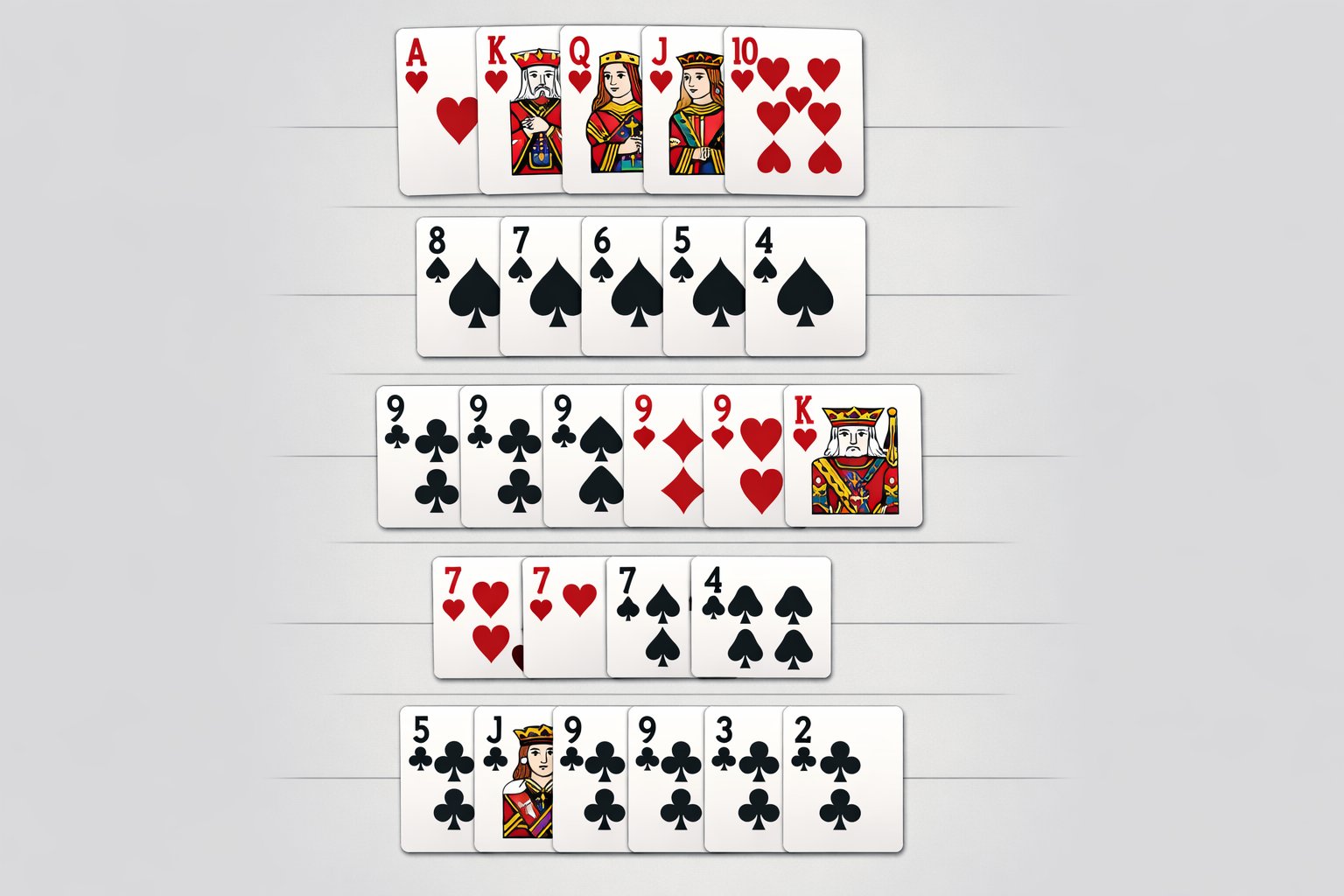
This ranking system stays the same across most poker games. Whether you play Texas Hold’em or Seven-Card Stud, you need to know these hand rankings. The order never changes, so once you learn it, you can use it in almost any game.
This guide will show you every poker hand in order and explain how each one works. You’ll learn what beats what, how to read a poker hands chart, and how to use this knowledge to make better decisions at the table. We’ll also cover the most common questions players have about hand rankings.
Official Poker Hands Ranked in Order
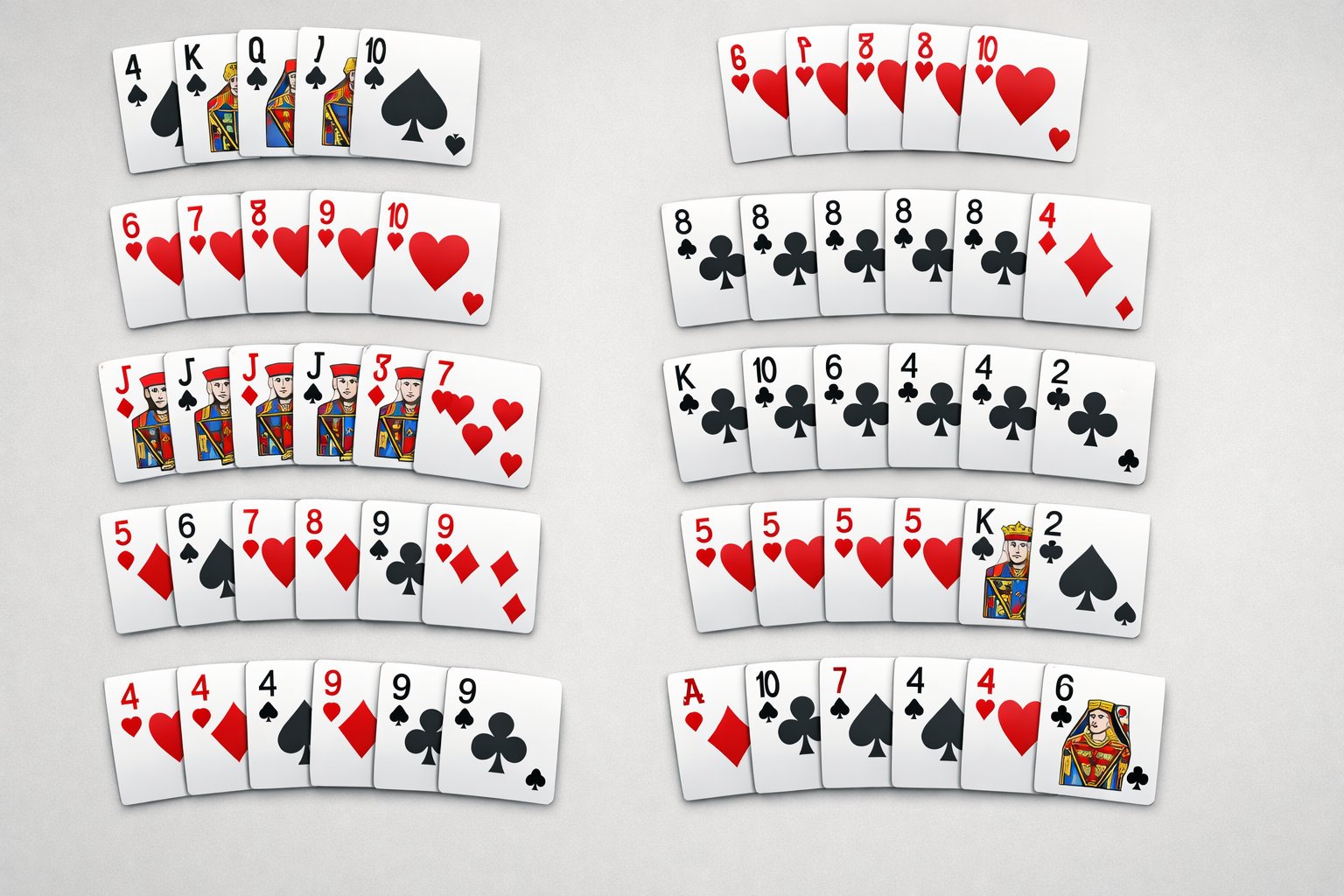
The top four poker hands represent the strongest combinations you can hold at any table. A royal flush stands as the absolute best hand in poker, followed by a straight flush, four of a kind, and a full house.
Royal Flush
A royal flush is the best hand in poker and the rarest combination you can make. This hand contains five specific cards: Ace, King, Queen, Jack, and 10, all in the same suit.
You cannot beat a royal flush with any other hand. All four suits hold equal value in poker, so a royal flush in hearts has the same strength as one in spades, diamonds, or clubs.
If two players somehow have a royal flush in games with community cards, they split the pot equally. This situation almost never happens because only one royal flush can typically exist with the cards available on the board.
Example: A♠ K♠ Q♠ J♠ 10♠
Straight Flush
A straight flush contains five cards of the same suit in sequential order. This hand ranks just below a royal flush on the poker hands chart.
The highest card in your sequence determines the strength of your straight flush. A Queen-high straight flush beats a Jack-high straight flush. An Ace-high straight flush is actually a royal flush, which gets its own special ranking as the best poker hands.
When multiple players hold a straight flush, the one with the highest top card wins the pot. A straight flush with 9-8-7-6-5 loses to J-10-9-8-7 because the Jack is higher than the 9.
Example: J♥ 10♥ 9♥ 8♥ 7♥
Four of a Kind
Four of a kind means you have four cards with the same rank, plus one additional card called a kicker. Your hand must contain five total cards, so the fifth card determines the winner if two players both have the same four matching cards.
The rank of your four matching cards matters first. Four 9s beat four 8s, and four Kings beat four Jacks. If you’re playing a game with community cards and two players share the same four of a kind, the kicker breaks the tie.
A player holding four 8s with a 6 kicker defeats a player with four 8s and a 5 kicker. The pot splits only if both the four matching cards and the kicker are identical.
Example: 8♠ 8♥ 8♦ 8♣ 6♠
Full House
A full house combines three cards of one rank with two cards of another rank. You need both a three of a kind and a pair to make this hand.
The three matching cards determine your hand’s strength first. Three Jacks with a pair of 7s beats three 10s with a pair of 7s. The pair only matters as a tiebreaker when multiple players have the same three of a kind.
If you hold three 10s with a pair of 8s, you beat someone with three 10s and a pair of 7s. When both the three of a kind and the pair match exactly in community card games, the pot splits between the tied players.
Example: 10♠ 10♥ 10♦ 7♠ 7♣
Flush, Straight, and High Card Explained
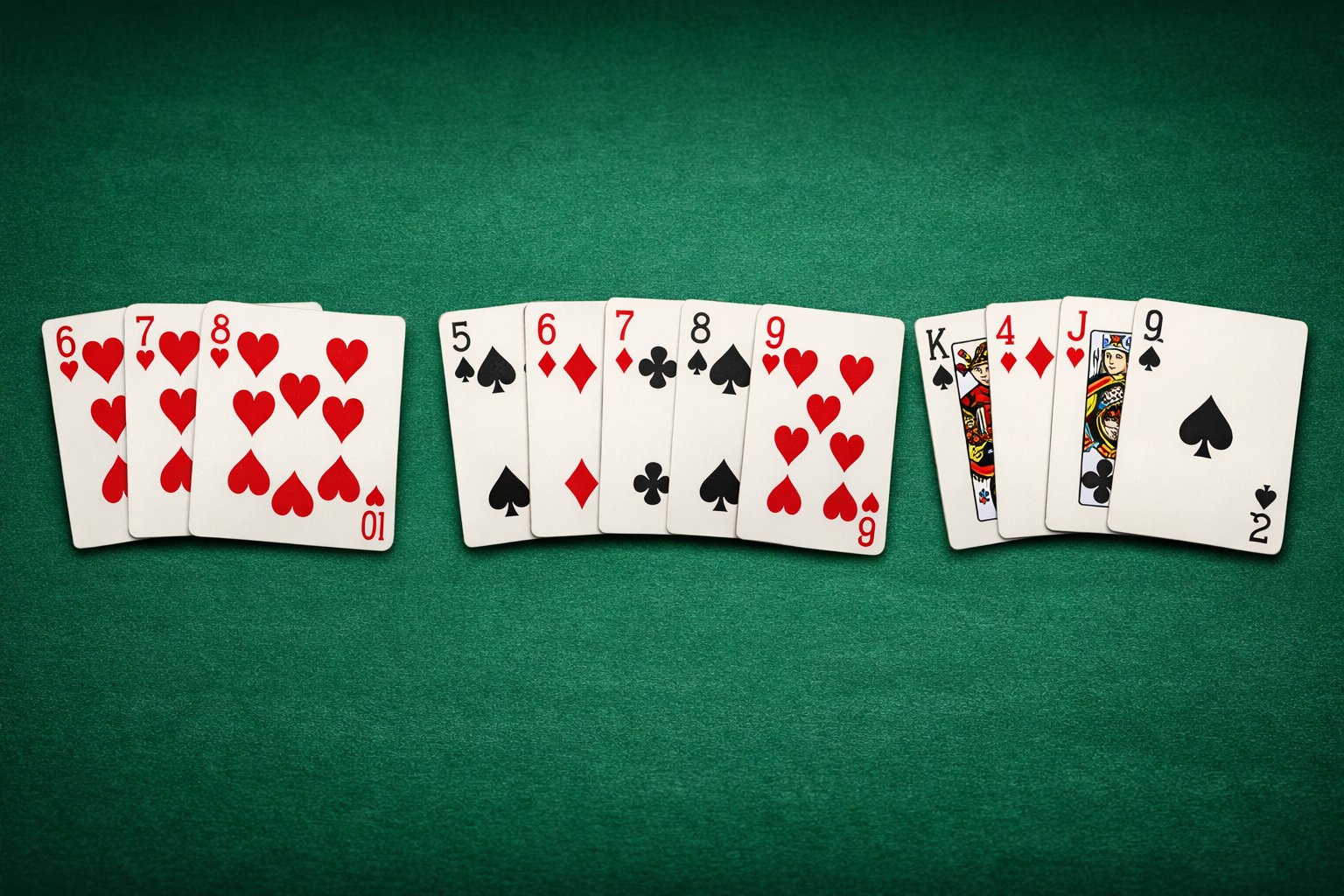
These three poker hands sit in the middle and lower end of the hand rankings, but they still play important roles in determining winners. A flush beats a straight, and a straight beats high card, but understanding how each works will help you make better decisions at the table.
Flush
A flush contains five cards of the same suit in any order. The cards don’t need to be in sequence. For example, you could have 2, 5, 9, Jack, and King all of hearts.
When two players both have a flush, the player with the highest-ranked card wins. If both players have the same highest card, you compare the next highest card, then the third, and so on until you find a difference.
All suits have equal value in poker. A heart flush has the same strength as a club flush if the card ranks are identical. If all five cards match in rank between two players (which can happen in community card games), the pot splits evenly.
Straight
A straight is five cards in sequence of any suit. The suits don’t need to match. For example, 7 of clubs, 8 of hearts, 9 of diamonds, 10 of spades, and Jack of hearts forms a Jack-high straight.
The highest card in your sequence determines your straight’s strength. A straight with 9, 10, Jack, Queen, King beats a straight with 8, 9, 10, Jack, Queen.
The Ace works in two ways. You can use it as the high card in the strongest straight (10, Jack, Queen, King, Ace) or as the low card in the weakest straight (Ace, 2, 3, 4, 5). You cannot wrap around—Queen, King, Ace, 2, 3 is not a valid straight.
High Card
If your five cards don’t make any of the ranked hands, you have a high card hand. The value comes from your highest-ranked single card. For example, if you hold King, 10, 7, 5, 2 of mixed suits, you have King high.
When comparing high card hands, start with the highest card. If both players have the same high card, move to the second-highest card, then the third, fourth, and fifth if needed. A hand with Queen, Jack, 9, 6, 4 beats Queen, Jack, 9, 6, 3 because of the higher fifth card.
High card hands are the weakest in poker. Any pair, two pair, or better will beat them.
The Middle and Lower Poker Hands
These hands show up more often at the table than premium holdings. While they don’t carry the same strength as straights or better, they still win pots regularly and require smart decision-making to play well.
Three of a Kind
Three of a kind means you have three cards of the same rank plus two unrelated cards. If you’re dealt pocket pairs like pocket aces, pocket kings, or pocket queens and hit a third matching card on the board, you’ve made a set. When you make three of a kind using one card from your hand and two from the board, it’s called trips.
The strength of your three of a kind depends on the rank of your three matching cards. Three jacks beats three tens. Three queens beats three jacks. If two players both have three of a kind, the higher-ranked set wins the pot.
When players share the same three of a kind (common in games with community cards), you look at the remaining two cards. The player with the highest unrelated card wins. If those match too, you compare the second unrelated card. For example, three fours with a jack and eight beats three fours with a jack and seven.
Two Pair
Two pair contains two cards of one rank, two cards of another rank, and one additional card. This hand ranks below three of a kind but beats one pair and high card hands.
When multiple players have two pair, the highest pair determines the winner first. A pair of aces and sixes beats a pair of kings and queens because aces rank higher. If the top pairs match, you compare the second pair. If both pairs are identical, the fifth card (called the kicker) decides the winner.
Starting with pocket pairs gives you one pair before the board even comes out. You need to match another card on the board to make two pair. The position of your pairs matters in tie situations, so pay attention to both pair values.
One Pair
One pair consists of two cards of matching rank plus three unrelated cards. This hand wins more often than high card alone but loses to everything else in the poker hands order.
Pocket pairs give you an immediate advantage since you start with a made hand. Premium pocket pairs like pocket aces, pocket kings, and pocket queens dominate lower pairs. Pocket aces beat pocket kings, which beat pocket queens, and so on down the line.
When two players both have one pair, the higher pair wins. A pair of tens beats a pair of nines. If players share the same pair, you compare the remaining three cards one at a time from highest to lowest. A pair of eights with an ace, king, and five beats a pair of eights with an ace, queen, and jack because the king is higher than the queen.
How to Use a Poker Hands Chart and Cheat Sheet
A poker hands chart shows you exactly which hands beat which, ranked from strongest to weakest. You can use a poker cheat sheet as a quick reference tool while playing online or studying the game at home.
Reading Poker Hand Rankings Charts
A poker hand rankings chart lists all possible hands in order from top to bottom. The best hand sits at the top, and the worst hand sits at the bottom. Any hand on the chart beats all hands below it and loses to all hands above it.
Most charts show an example of each hand type next to its name. You’ll see Royal Flush at the top, followed by Straight Flush, Four of a Kind, Full House, Flush, Straight, Three of a Kind, Two Pair, One Pair, and High Card at the bottom.
Some poker hands cheat sheets also include extra details like odds and probabilities. These numbers tell you how likely you are to make each hand. This information helps you understand why stronger hands are worth more.
Printable Poker Hand Rankings Guide
A printable poker hand rankings guide works best when you’re playing online at home. You can keep it next to your computer screen for quick reference. Just remember that using printed charts at live casino tables is not allowed and will make you look inexperienced.
Print your chart in color if possible so you can easily see the different suits. Make sure the text is large enough to read quickly during a hand. Keep it somewhere within easy view but not directly in front of you where it becomes a distraction.
You should only use a poker hand cheat sheet until you memorize the rankings. Most players need the chart for just a few sessions before the order becomes natural.
Poker Hand Cheat Sheet
A poker cheat sheet includes more than just hand rankings. Many sheets show starting hand charts that tell you which hands to play from different positions. They might also include pot odds calculations and common betting patterns.
Basic elements found on most poker hands cheat sheets:
- Complete hand rankings with examples
- Tie-breaker rules and kicker explanations
- Starting hand recommendations by position
- Basic odds and probability percentages
You can find free downloadable poker hand cheat sheets online in PDF format. Choose one that matches your skill level. Beginners need simple charts with just the basics, while experienced players benefit from sheets with advanced statistics and ranges.
Poker Hand Rankings in Texas Hold’em
In Texas Hold’em, you combine your private hole cards with shared community cards to make the best possible five-card poker hand. The same hand rankings apply to all forms of poker, but how you construct those hands differs based on the cards available to you.
Hole Cards and Community Cards
You receive two hole cards face down at the start of each Texas Hold’em hand. These cards belong only to you. Five community cards are then dealt face up in the center of the table in three stages: the flop (three cards), the turn (one card), and the river (one card).
Every player at the table can use these community cards. You can use both of your hole cards, one hole card, or neither of your hole cards to make your final hand. The goal is to make the strongest five-card combination possible.
Your hole cards give you an advantage when they work well with the community cards. Strong starting hands like pocket aces or kings give you the best chance to win, but any two cards can potentially make a winning hand by the river.
Making the Best Five-Card Hand
You must select exactly five cards from the seven total cards available to you (two hole cards plus five community cards). You pick whichever five cards create the highest-ranking poker hand.
For example, if the board shows four hearts and you hold one heart, you have a flush using five hearts total. If the board shows a straight and your hole cards don’t improve it, you play the board. You always play your best possible five-card combination.
The strength of your hand can change dramatically as new community cards are revealed. A pair of aces in your hand might be the best hand on the flop but lose to a flush by the river.
Split Pot Scenarios
A split pot occurs when two or more players have identical hand rankings at showdown. The pot is divided equally among the winning players.
This happens most often when the five community cards make the best possible hand. If the board shows a straight and none of your hole cards improve it, you tie with anyone else who also can’t beat the board.
Split pots also occur when players have the same hand value. Two players with ace-high flushes in the same suit would split the pot. Kickers matter only when they’re part of the five-card hand being played.
Strategy Tips: Understanding Hand Strength and What Beats What
Knowing which poker hands beat others helps you make better decisions at the table. The key is understanding when your hand is strong enough to bet and when you should fold based on what your opponents might hold.
Relative Value of Poker Hands
Hand strength changes based on the situation. A pair of aces is the best starting hand in Texas Hold’em, but it becomes weaker if the board shows three cards of the same suit and you don’t have that suit.
Your position at the table matters too. Strong hands like top pair with a good kicker play better when you act last because you see what others do first. Weaker hands like middle pair need more caution in early position.
Context affects value:
- Royal flush and straight flush are always strong
- Full house and four of a kind rarely lose
- Flush and straight are solid but can be beaten
- Two pair and three of a kind are good but vulnerable
- One pair depends heavily on the pair rank and board texture
You need to think about how many players are in the hand. A pair of kings might win against one opponent but loses value when five players stay in the pot.
Hand Ranking and Tie-Breakers
Tie-breakers determine the winner when players have the same hand category. For straights and straight flushes, the highest top card wins. A straight ending in ace beats one ending in king.
Full houses compare the three-of-a-kind first, then the pair. Kings full of threes beats queens full of aces because the trips rank matters more than the pair rank.
When players have the same pair, you compare kickers in order from highest to lowest. If you hold A♠A♥K♦9♣5♠ and your opponent has A♣A♦Q♠J♥10♣, you win because your king kicker beats their queen kicker.
Tie-break order for common hands:
- Four of a kind: Quad rank, then kicker
- Two pair: Top pair, second pair, then kicker
- Three of a kind: Trips rank, then both kickers
- High card: Compare each card from highest to lowest
Suits don’t break ties in standard poker rules. If the board shows a straight or flush that all players use, the pot splits equally among them.
Improving Hand Selection
Playing too many hands is a common mistake. Focus on winning poker hands that have strong potential before the flop. Premium pairs like aces, kings, and queens should almost always be played.
Connected cards of the same suit like J♠10♠ or 9♥8♥ have value because they can make straights and flushes. These hands work best when you can see the flop cheaply from late position.
Fold weak hands that rarely win big pots. Low unconnected cards like 7♣2♠ or 9♦3♥ put you at a disadvantage from the start. Even if you make a pair, you’ll often lose to better pairs or stronger kickers.
Starting hand guidelines:
- Raise with premium pairs (AA through JJ) and strong aces (AK, AQ)
- Call with medium pairs (TT through 77) and suited connectors
- Fold trash hands that can’t make strong combinations
- Adjust based on position and opponents
Your hand selection should tighten in early position and loosen in late position. You can play more speculative hands when you act last because you have more information about what other players are doing.
Frequently Asked Questions
Poker hand rankings follow a specific order based on how rare each combination is to make. Understanding the probabilities and rules helps you make better decisions at the table.
What is the hierarchy of poker hands from highest to lowest?
The complete ranking from best to worst is: Royal Flush, Straight Flush, Four of a Kind, Full House, Flush, Straight, Three of a Kind, Two Pair, One Pair, and High Card. A Royal Flush consists of A-K-Q-J-10 all in the same suit and cannot be beaten.
A Straight Flush is five consecutive cards of the same suit, like 9-8-7-6-5 of hearts. Four of a Kind means you have four cards of the same rank, such as four Kings.
A Full House combines three cards of one rank with two cards of another rank. A Flush contains five cards of the same suit that are not in sequence. A Straight has five consecutive cards of mixed suits.
Three of a Kind is three cards of the same rank. Two Pair means you have two different pairs in your hand. One Pair is simply two cards of the same rank, and High Card is when you have none of these combinations.
How are poker hands ranked in games like Texas Hold’em and Omaha?
Both Texas Hold’em and Omaha use the same hand ranking system. The difference lies in how you form your five-card hand.
In Texas Hold’em, you receive two private cards and share five community cards with all players. You can use both your private cards, one private card, or no private cards to make your best hand.
Omaha deals you four private cards instead of two. You must use exactly two of your private cards and exactly three community cards to form your hand. This rule makes Omaha hands play differently even though the rankings stay the same.
What probability does each poker hand have of occurring?
A Royal Flush has the lowest probability at roughly 1 in 31,250 hands when playing to the river in Texas Hold’em. This translates to about 0.0032% chance.
A Straight Flush occurs approximately 1 in 3,590 hands. Four of a Kind appears about 1 in 595 hands. A Full House happens roughly 1 in 38 hands.
A Flush comes up about 1 in 33 hands. A Straight occurs approximately 1 in 21 hands. Three of a Kind appears roughly 1 in 20 hands.
Two Pair happens about 1 in 3.3 hands. One Pair is the most common made hand, occurring roughly 1 in 1.4 hands. High Card is actually less common than One Pair when all seven cards are in play.
These probabilities assume you see all five community cards. Most hands end before the river, so actual frequencies vary based on how players bet.
Can you list all possible poker hands in a ranking chart?
From strongest to weakest, the ten poker hands are organized by rarity. Royal Flush sits at the top, followed by Straight Flush, Four of a Kind, Full House, Flush, Straight, Three of a Kind, Two Pair, One Pair, and High Card.
Each hand beats all hands listed below it. When two players have the same hand type, the higher-ranked cards within that hand type win.
For example, three Kings beat three Jacks. A flush with an Ace high beats a flush with a King high. If the main hands are identical, the remaining cards called kickers determine the winner.
What are the best starting hands in Texas Hold’em poker?
Pocket Aces (two Aces) is the strongest starting hand in Texas Hold’em. Pocket Kings come second, followed by pocket Queens.
Ace-King suited ranks as the fourth-best starting hand because it can make strong pairs, straights, and flushes. Pocket Jacks take the fifth spot.
Other strong starting hands include Ace-Queen suited, Ace-King offsuit, pocket Tens, and Ace-Jack suited. Pocket Nines and Ace-Ten suited also play well.
High pairs give you immediate strength. High cards of the same suit offer flush possibilities along with straight potential. The closer your two cards are in rank, the better your straight chances become.
How can I use a poker hands cheat sheet to improve my game?
A cheat sheet helps you quickly reference which hands beat which during play. Keep it nearby when you start learning so you don’t make costly mistakes about hand strength.
Use the sheet to study hand rankings away from the table. Review it before each session until the order becomes automatic. This prevents confusion when you need to make quick decisions.
A good cheat sheet also shows starting hand strength for pre-flop decisions. Compare your hole cards to the chart to decide whether to fold, call, or raise.
Many sheets include probability information that helps you understand how likely you are to improve your hand. This data guides your betting choices on later streets.